
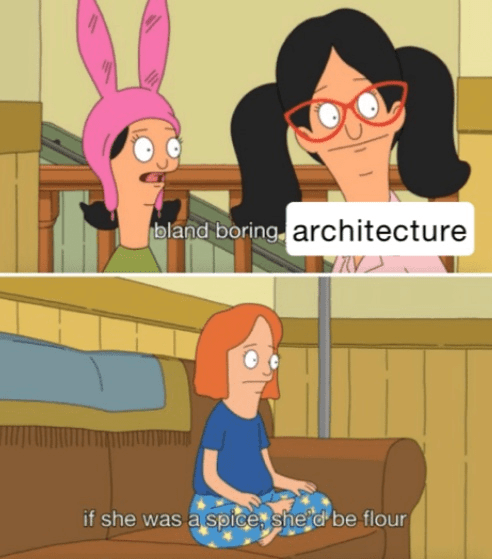
To quote Louise Belcher, the sarcastic nine-year-old from Bob’s Burgers, “And then there’s Jessica. Bland, boring Jessica. If she was a spice, she’d be flour. If she were a book, she’d be two books.” Replace “Jessica” with “architecture,” and you have a sentiment commonly found among those outside the discipline.
People find architecture boring.
Sure, there are architecture lovers out there besides those who have studied it, like the students, professors, and licensed architects. But not everyone feels the same way about it.
So, why do people think architecture is boring?
I have three possible theories why. The delivery in which architects talk and behave, the context often needed to understand (and appreciate) architecture, and the fact that architecture is often just the background to everyone’s life.
The delivery:
Like a lot of disciplines, architecture has its own jargon that can confuse people. I remember my freshman year feeling completely out of my element, hearing words like “juxtapose,” “tectonic,” or “parallax,” just to name a few. Only a few years later, to be sprinkling these words in casual conversations with my colleagues.
Immersion can be a great way to learn a new language, but when you’re talking to someone new to the field or even outside the discipline, you need to learn to code-switch. When you don’t understand what’s being said, it can be easy to become bored and tune out. Know your audience. They shouldn’t have to keep a dictionary with them just to have a conversation with you.
The professor or architecture lover’s personal enthusiasm for the subject can play a role as well. It’s so much easier to learn from someone who is clearly passionate about their subject. In my personal experience, even if I didn’t enjoy a class, if the professor was excited and having fun, I’d be more likely to as well. On the contrary, if the person seemed bored or apathetic, I’d have a hard time following along.
The context:
People have opinions on aesthetics, and that will never change. However, I believe that part of the hate for “modern architecture” comes from the lack of knowledge of the history behind it. And to my surprise, every time, there are people out there who hated history in school (couldn’t be me). Some people see history as facts and dates, others (like me) as stories.
Often, people see those modern boxes and are turned away. “There’s no character, it all looks the same, it feels cold.” Once again, they are allowed to have their opinions on architectural styles. But I think it’s important to understand why those modern boxes exist in that context. Architects didn’t suddenly go from designing baroque cathedrals to the modern boxes. Architecture has as much to do with politics, economics, and society as it does with aesthetics.
The industrial revolution led the way to new materials, which allowed new building types like the skyscraper to be built. With these new types and materials, architects wanted to create new styles that reflected the possibilities of the new ideas and technology.


For example, take these two museums in Cleveland. The MoCA (Museum of Contemporary Art) reflects a contemporary architectural style on its exterior to mirror the modern art inside. The Cleveland Museum of Art isn’t even all Neoclassical. However, the art inside (like the Michelangelo exhibit from 2019) could be argued reflects more of that “classical” style. There are reasons behind these stylistic architectural decisions.
The ordinary background:
Much like in movies or TV, whether cartoon or live action, to some people, the backgrounds in this media form are often just that, backgrounds. Some people only see the actors, the greater overall story. Others revel in seeing the details in costume designs, props, or the backgrounds. I’m sure you can guess by now that I am the latter.

Unfortunately, to some people, architecture is truly “architecture” with a lower case “a.” All they see is a building. And even worse, in today’s capitalistic society, “buildings” are being built more than “Architecture.” Real-world constraints like time and money play a huge role in this. Sometimes a client just needs another new, standard, boring office building. And when there are more “buildings” instead of “Architecture,” it is easy for it to fade into the background of people’s lives.
Why does it matter if people think architecture is boring?
Architecture affects everyone. Whether they realize it or not, it’s always a constant in the background. It can affect your emotions. Bad architecture can create hostility and even safety concerns (beyond just structural failures, although that can be an issue too). If people don’t feel safe gathering in a space, then why would they use it?
Then there are even architectural elements in cities to try to prevent the homeless from using public spaces. It’s called Hostile Architecture, and an example of this can include seat dividers on benches, so people can’t sleep on them. Last time I checked, public spaces are public. Everyone should be able to use them.

And for far too long, architecture has been a white, male-dominated profession. While statistics have been improving from a diversity standpoint (NCARB by the Numbers 2025), there’s always room to grow. Having different perspectives in the studio or the firm can only benefit society as a whole. We need more voices to speak for those who haven’t had a voice in the past.
And now with architecture no longer being considered a “professional” degree, more barriers could be created for this profession for those who want to become licensed architects but can’t afford the education.
What can we do? How can we get people to pay attention?
Educate. Make architecture education more accessible. Ease up on the architecture lingo; save that for your professors when you’re trying to sound like you know what you’re talking about. They say the best way to show you know a subject is to teach it. Can you explain to your non-architecture friends what your design is? Can you compare an architectural concept to something in the media? (Like how the whole idea for this post came from a silly quote from Bob’s Burgers?)
Lastly, don’t be boring. Have interests outside of architecture. Have friends outside of the discipline. Don’t conform to stereotypes just because it’s what is expected. The world doesn’t need another starchitect. We need more individuals passionate about creating the spaces we live in -and those that become the backgrounds of our lives.
What do you think? How will you defend architecture the next time someone calls it “boring?” Will you jump to the discipline’s defense or agree with them and continue to understand where they’re coming from? Or maybe there’s another reason you believe people think architecture is boring. Let me know!